
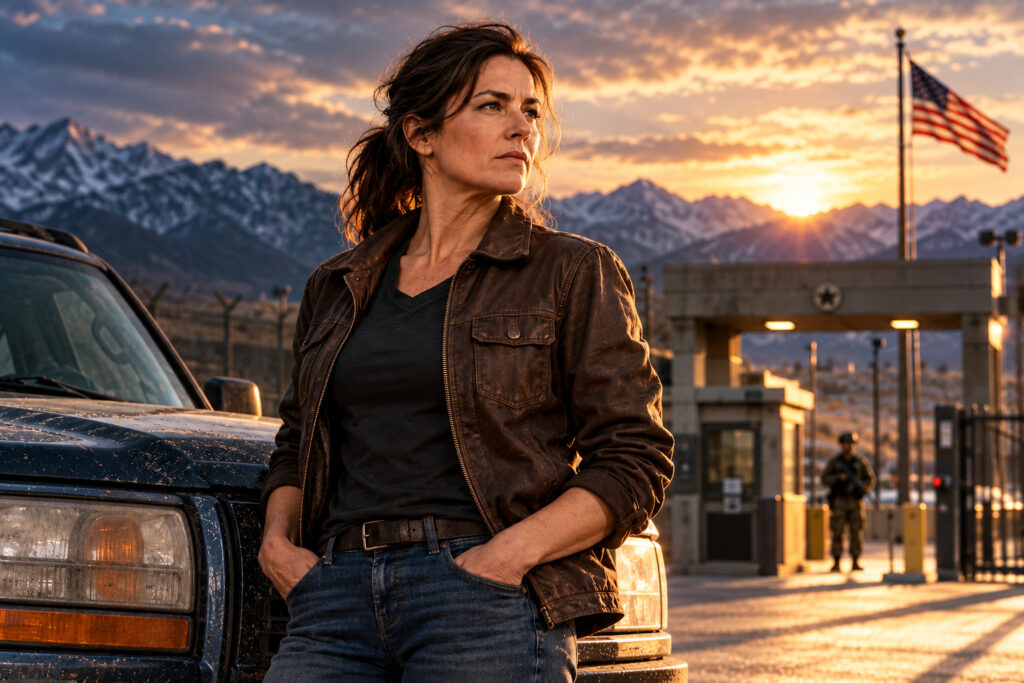
The message that finally brought Jamie back into her life arrived just after four o’clock.
This time, it contained a telephone number and a short instruction.
Call when you’re alone.
Mara stared at the screen for several seconds before walking into an empty office and closing the door. Through the window, she could see Mercer speaking urgently with two senior officers who had arrived from the installation headquarters. Whatever happened next, the quiet evaluation he’d planned was turning into something considerably more serious.
She dialed the number.
The call connected almost immediately.
For a moment, neither person spoke.
Then a man’s voice said, “You still answer the phone like you’re expecting somebody to ask you to fix a truck?”
Mara sat down heavily.
She knew that voice.
It was older, rougher and carrying an unfamiliar weariness, but the gentle amusement beneath the words was unmistakable.
“Jamie?”
“Hello, Sergeant.”
She pressed a hand against her forehead, suddenly unable to decide whether she wanted to laugh, cry or reach through the telephone and strangle him.
“Do you have any idea what you’ve put me through today?”
“More than you know.”
“I buried you, Jamie. Not literally, because they wouldn’t let me see the body, but I went to your memorial service. I sat beside your wife while they folded a flag and told her you’d died serving your country.”
“I know.”
The quiet misery in his voice made her pause.
“Then you’d better have a very good explanation.”
“I do, Mara. But I need you to listen before you decide whether to hate me.”
She looked toward the closed office door.
“Go on.”
Jamie told her that the evacuation helicopter had diverted to a temporary medical station operated by a private contractor. His injuries had been serious, but survivable, and he’d regained consciousness two days later in a facility he didn’t recognize. By then, he’d been informed that his military records listed him as deceased and that his survival created a significant security problem.
“They told me the operation had involved classified equipment, and that I’d been exposed to information I wasn’t authorized to know. I was given a choice between cooperating with a security investigation or facing charges for disclosing protected material.”
Mara listened without interrupting, although her anger was becoming increasingly difficult to contain.
“Who gave you that choice?”
“People working for Pike. I didn’t know who they really were at first.”
“And you believed them?”
“I was twenty-four, Mara. I’d nearly died, I was taking enough pain medication to knock out a horse, and every officer who came through that door told me the same thing. By the time I understood what was happening, they’d already told my family I was dead.”
She closed her eyes, trying to imagine the terror and confusion of waking in an unfamiliar facility only to discover that the world had been informed of your death.
“What happened afterward?”
“They moved me between medical facilities while I recovered. When I was well enough to walk, they offered me a new identity and a civilian job overseas. They controlled the documents, my travel and even the telephone numbers I was allowed to use. They said it was temporary, that the investigation would eventually be resolved and I’d be allowed to contact my family. By the time I realized the promises meant nothing, my old identity had been erased from every record I could reach.”
“But it never was.”
“No.”
Mara heard him take a breath.
“After a while, I realized I wasn’t being protected. I was being kept out of sight because I’d seen the equipment on the ridge. I’d heard the technicians arguing over the surveillance feeds before the patrol entered Kandar. I knew the intelligence had been altered, and I knew it wasn’t an accident.”
“Why didn’t you come forward?”
“I tried. Twice. The first time, the lawyer I contacted disappeared from the case after meeting with someone from the government. The second time, I received photographs of my wife and daughter outside their house. The message was clear enough.”
Mara looked down at her hands. She had spent nine years angry with the Army for what it had done to her, but she’d never considered that Jamie might have spent those same years living under a threat he couldn’t escape.
“Are they safe now?”
“Yes. My wife remarried a few years after I was declared dead. My daughter is nearly ten. I’ve watched her grow up in photographs, and until recently, I didn’t dare do anything else.”
The sadness in his voice was almost unbearable.
“Jamie, you should have told me.”
“I wanted to. But you were the one person who’d questioned the intelligence before the operation. If I’d contacted you, they’d have known immediately that I was trying to expose what happened.”
Mara rubbed her eyes.
“So why now?”
“Because Meridian is developing a new system using the same technology, and Pike is involved again. I found out they were planning another field evaluation, and I realized they were about to repeat the same mistakes.”
“The equipment on the eastern ridge?”
“Mine.”
She sat upright.
“You put it there?”
“I arranged for it to be placed there. I had a former Meridian technician help me rebuild a decommissioned demonstration unit, and he got it onto the ridge before the exercise under the cover of an authorized equipment delivery. He kept a copy of the delivery paperwork. I know we broke rules, Mara, but we configured the unit to demonstrate false readings, not to harm anyone. I needed somebody who would recognize what was happening, and I knew you would.”
“And the truck?”
“That was mine too. The Army report called it destroyed, but it was recovered after Kandar and quietly shipped back into storage. Years later it was sold as surplus with its history scrubbed from the paperwork. I tracked it down through an old maintenance number, bought it through a dealer and had the original markings restored. I thought you deserved to know that not everything in the report was true.”
Mara stared at the wall.
“You could have sent me a letter.”
“I did. You didn’t answer.”
“What letter?”
“The one I sent to your house in Montana last month. It was deliberately vague because I couldn’t risk putting the evidence in the mail.”
Mara thought back to the pile of mail she’d left unopened on the kitchen counter. Somewhere among the utility bills, equipment catalogs and advertisements for agricultural insurance, there might have been an envelope she’d mistaken for another attempt to sell her something.
She sighed.
“Well, that’s embarrassing.”
Jamie laughed, and for a moment she heard the young corporal she’d known in Afghanistan.
Then his voice became serious.
“Mara, there’s something else. Sloane knows I’ve been collecting evidence, and he’s trying to destroy the records before investigators can examine them. The system failure wasn’t part of my plan. I wanted ARGUS to expose the false target, not shut down completely.”
Mara’s thoughts returned to the command logs Ortega had recovered.
“Then Sloane triggered the shutdown when we found your equipment.”
“That’s what I believe. He’s been working with Pike for years, and he knows exactly how much trouble those records could cause.”
“Where are you now?”
“Close enough to come in, if you can guarantee I won’t disappear into another secure facility.”
Mara considered the question carefully.
She couldn’t guarantee anything of the sort. The Army had failed Jamie once, and there was no reason to assume that every institution involved would suddenly behave honorably simply because the truth had become inconvenient.
But she could make sure he wasn’t alone.
“I’ll speak to the investigators,” she said. “Not Pike’s people, and not anyone connected with Meridian. We’ll arrange for you to meet them with a lawyer present, and I’ll be there myself.”
“Still looking after your soldiers, Sergeant?”
“Somebody has to. You were always hopeless at looking after yourself.”
He laughed again, although this time the sound was unsteady.
“Thank you, Mara.”
“Don’t thank me yet. When I see you, I’m going to be extremely unpleasant for at least ten minutes.”
“I’d expect nothing less.”
Before Jamie surrendered himself to investigators, Mara insisted on one last meeting with Ortega and the installation security officer. She had spent too many years watching evidence pass from one office to another until nobody could remember who had first handled it, and she was determined that the same thing would not happen again.
With Ortega beside her, she compared the original Kandar photographs with the recovered ARGUS recordings, tracing the matching equipment housings and the changes in surveillance readings. The comparison did not prove who had ordered the deception, but it established a pattern that investigators could test against maintenance records, procurement documents and the preserved command logs.
“Don’t write that the system malfunctioned,” she told the officer preparing the incident summary. “Write that someone altered its inputs, and identify which evidence supports that conclusion. If you call it a malfunction now, someone will spend the next nine years insisting that was all it ever was.”
The officer looked toward Mercer, who had joined them at the table. Mercer did not intervene or soften her words. Instead, he asked Ortega to attach the original logs and ordered that the report record Mara’s observations in full, with her name beside them. It was a small correction to the way things had been done at Kandar, but Mara felt its weight as she watched the officer make the changes.