Chapter One: The Invitation
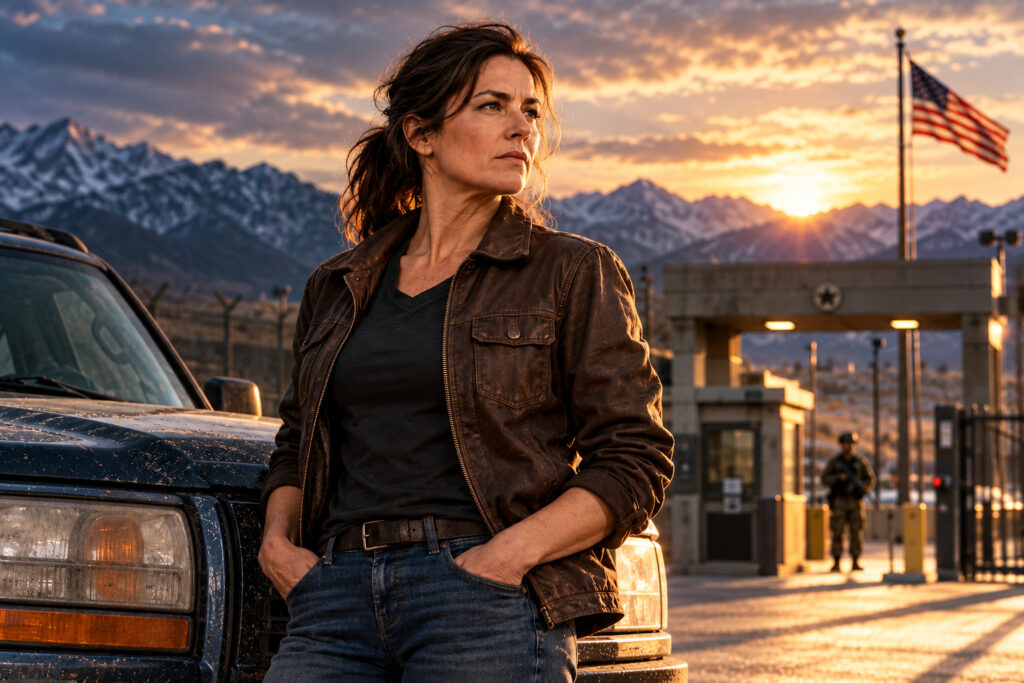
The first thing Mara Whitcomb noticed about Fort Calder was that someone had finally painted the main gate, although they’d apparently chosen the same miserable shade of beige that the Army had been using since the invention of concrete. The second was that the young soldier checking identification looked barely old enough to have finished high school, let alone been entrusted with guarding a military installation.
He studied her driver’s license, glanced at the battered Ford pickup she’d driven all the way from Montana, and returned his attention to the license with the faintly puzzled expression of someone trying to reconcile two pieces of information that didn’t belong together.
“You’re here for the evaluation, ma’am?”
“Unless there’s another Fort Calder hiding somewhere in Wyoming, which wouldn’t surprise me. The Army was always fond of keeping things unnecessarily complicated.”
The soldier didn’t smile, although Mara suspected that had more to do with nervousness than a lack of humor. He consulted the tablet mounted beside his window, scrolled through several screens and suddenly sat a little straighter.
“Sergeant Whitcomb?”
“Former Sergeant Whitcomb. These days, it’s just Mara, and most people only use that when they want something repaired.”
“Yes, ma’am. Colonel Mercer’s office has been expecting you. You’ll want the northern training complex, about two miles along the main road. Follow the signs for Building Twelve.”
He handed back her license with considerably more respect than he’d shown when she arrived, leaving Mara to wonder what exactly Colonel Mercer had told the gate staff. Whatever it was, she hoped it didn’t involve the word distinguished. In her experience, that particular description usually preceded an invitation to attend something tedious.
As she drove through the installation, she found herself recognizing landmarks she hadn’t thought about in years. The old maintenance hangar was still standing, although someone had replaced its rusting doors, and the parade ground where she’d once spent three miserable hours waiting for a visiting general had been transformed into a parking area for expensive tactical vehicles. Beyond the buildings, the Wyoming mountains rose against a clear autumn sky, looking exactly as they had when she’d last seen them.
Nine years. It was remarkable how quickly a place could drag you backward.
On the passenger seat lay the letter that had brought her here, folded along the same creases she’d made when it arrived three weeks earlier. The invitation had been formal, polite and remarkably uninformative, requesting her participation in an independent evaluation of an experimental battlefield surveillance system. It had included travel expenses, accommodation arrangements and the signature of a colonel she’d never heard of, but absolutely nothing about why the Army had suddenly developed an interest in a woman who now spent her days repairing agricultural machinery outside Livingston.
Mara had nearly thrown it away. In fact, she’d carried it as far as the kitchen trash can before curiosity, that old and occasionally disastrous companion, persuaded her to read it again.
What troubled her wasn’t the invitation itself. Civilian specialists were regularly consulted on military projects, and although she hadn’t worn a uniform in nearly a decade, she still understood the practical business of reconnaissance better than most people understood their own kitchen appliances.
What troubled her was the name buried halfway down the second page.
Colonel Daniel Mercer.
The last time she’d seen Daniel, he’d been standing outside a field hospital in Afghanistan with blood on his sleeves, trying to explain how six men had died during an operation that should never have gone ahead.
He hadn’t believed her warnings then.
She wondered whether he’d invited her because he finally did.
Mara parked outside Building Twelve, switched off the engine and remained behind the wheel for a moment, studying the modern glass-fronted structure that had replaced the collection of temporary offices she remembered from her last visit. Someone had planted ornamental grasses along the entrance, presumably in an attempt to make the place look less like a military installation and more like the headquarters of an insurance company. The effect was spoiled somewhat by the armed security patrol walking past the windows.
She checked her reflection in the rearview mirror, decided there was very little she could do about it, and climbed out of the truck.
At forty-six, Mara had developed a comfortable disregard for other people’s opinions about her appearance. Her dark hair was pulled into a practical ponytail, her jeans had been washed enough times to lose their original color, and the brown leather jacket she’d owned for nearly fifteen years had a small burn mark on one sleeve from an unfortunate encounter with a welding torch. She was clean, reasonably presentable and had remembered to remove the grease from beneath her fingernails before leaving home. As far as she was concerned, that constituted dressing for the occasion.
A young lieutenant intercepted her just inside the entrance, carrying a clipboard and wearing the determined expression of someone who had been given responsibility for an important event without being told quite how important it was.
“Can I help you, ma’am? Civilian contractors are supposed to report to the administration desk in Building Four.”
“I’m here for the surveillance evaluation. Mara Whitcomb.”
The lieutenant checked his list, and his expression shifted from polite dismissal to mild confusion.
“You’re the independent observer?”
“Apparently. Although if you’ve got someone more suitable hiding in a cupboard, I won’t be offended.”
He looked uncertain whether she was joking, which Mara had always considered one of the more entertaining benefits of getting older.
“No, ma’am. Colonel Mercer asked me to bring you directly to the briefing room. If you’ll follow me, please.”
He led her along a corridor decorated with framed photographs of soldiers participating in various training exercises. In every picture, the men and women appeared clean, cheerful and remarkably enthusiastic about whatever task they were performing. Mara remembered military exercises rather differently, particularly one memorable week in Germany when it had rained continuously, half the vehicles had broken down, and a visiting brigadier had demanded to know why everyone looked so miserable.
The lieutenant stopped outside a conference room and opened the door.
Inside, approximately twenty people were gathered around a long table dominated by a bank of large monitors. Several wore Army uniforms, while the remainder appeared to be civilian technical specialists, identifiable by their expensive watches and the slightly proprietary way they regarded the equipment. At the far end of the room, a tall officer with closely cropped gray hair was speaking to a man in a dark suit.
Daniel Mercer turned as she entered.
For a brief moment, his carefully composed expression faltered, and Mara caught a glimpse of the exhausted young major she’d known in Afghanistan. Then he smiled, crossed the room and offered his hand.
“Mara. I’m glad you came.”
She shook it, noticing that he’d acquired a colonel’s insignia and several additional lines around his eyes since their last meeting.
“That’s a rather optimistic statement, Daniel. I’ve only just arrived.”
His smile became more genuine. “Still making friends wherever you go, I see.”
“I find it saves time to disappoint people early.”
He laughed quietly, although there was something strained beneath the amusement. Mara wondered how long he’d been rehearsing this reunion and whether he’d expected her to arrive demanding answers about the past. If so, he was going to be disappointed. She’d spent nine years learning how to live without those answers, and she wasn’t about to start an argument in front of an audience.
Mercer introduced her to the room as an independent operational observer, a description that sounded considerably more impressive than anything Mara had written on her tax returns recently. Most of the officers acknowledged her politely, although one captain seated near the front examined her with the open skepticism of a man who believed that expertise could be measured by the number of ribbons on a uniform.
“Colonel, may I ask what Ms. Whitcomb’s qualifications are?” he said before Mercer had finished the introductions.
Mercer regarded him for a moment. “You may, Captain Rourke, although I would suggest allowing our guest to sit down first.”
Mara pulled out a chair near the back of the room. “It’s all right, Colonel. I’d be curious myself.”
Rourke appeared encouraged by her response. He was in his early thirties, broad-shouldered and meticulously turned out, with the sort of confident bearing that usually came from being exceptionally good at something or having been told repeatedly that you were. Mara hadn’t yet decided which applied.
“We’re evaluating one of the most sophisticated battlefield surveillance platforms currently under development,” he explained. “The operational environment has changed significantly over the past decade, and our assessment requires people with current tactical experience.”
“That sounds sensible,” Mara agreed.
Rourke hesitated, apparently having expected an argument.
“So you’ll understand my concern about bringing in someone whose experience may no longer be relevant.”
“I understand it perfectly. You don’t know who I am, you haven’t seen my service record, and you’ve concluded that Colonel Mercer must have invited me because we went to school together.”
A faint smile appeared on the face of a young specialist sitting beside the monitors.
“That’s not what I said,” Rourke replied.
“No, Captain. It’s what you were working your way toward, and I thought I’d save us both some time.”
Mercer cleared his throat before the exchange could develop further. “Captain Rourke has been overseeing the operational testing of ARGUS for the past six weeks. He’s understandably protective of his team.”
“Of course he is,” Mara said pleasantly. “If I’d spent six weeks teaching a machine to do my job, I’d be protective of it too.”
This time, the young specialist failed to conceal his amusement.
Rourke looked as though he wanted to respond, but Mercer had already turned toward the main display.
“Let’s get started. We have a full afternoon ahead of us.”
The presentation began with an explanation of ARGUS, an integrated surveillance platform that combined thermal imaging, aerial reconnaissance, ground sensors and automated threat analysis. Its developers claimed that the system could identify concealed enemy positions more accurately than conventional reconnaissance teams, particularly in difficult terrain where visibility and communication were unreliable.
Mara listened carefully, making occasional notes in a small notebook she’d brought from home. She was impressed by some of the technology, particularly the way ARGUS combined information from multiple sources, but she was less convinced by the confident predictions appearing on the screens. Computers were extraordinarily good at finding patterns, provided someone had taught them which patterns mattered. They were considerably less reliable when the information they received was incomplete, misleading or deliberately manipulated.
After forty minutes, Rourke moved on to the practical evaluation.
A simulated hostile force had been positioned somewhere within a twelve-square-mile training area east of the installation. ARGUS would analyze the available surveillance feeds, identify likely enemy positions and guide a reconnaissance team toward the target. The exercise had been designed to test both the system’s accuracy and the soldiers’ ability to interpret its recommendations.
“Under normal conditions, we’d expect the system to identify the primary target within twenty minutes,” Rourke explained, displaying a map of the surrounding terrain. “Our operators have already completed preliminary scans, and ARGUS has flagged three possible locations.”
Mara studied the map. The training area included a dry creek bed, two steep ridgelines and a broad valley scattered with scrub vegetation. It was familiar country, although she couldn’t remember having trained in that particular sector before.
“Can you show us the earlier thermal images?” she asked.
Rourke glanced toward her. “The system has already incorporated those into its analysis.”
“I’m sure it has. I’d still like to see them.”
He looked at Mercer, who nodded his approval.
A specialist brought up a sequence of images recorded over the previous half hour. Mara examined them without speaking, comparing the changing shadows, the temperature variations across the rocky slopes and the faint tracks visible in the dry ground.
Something about the eastern ridge caught her attention, although she couldn’t immediately explain what it was. She asked the specialist to display two images side by side, then leaned forward to study a narrow section beneath a rocky overhang.
“Is there a problem?” Rourke asked.
“Not necessarily. Could you increase the contrast here?”
The specialist adjusted the image, revealing a darker patch against the surrounding stone.
Rourke folded his arms. “That’s a natural shadow. The system has already classified it as environmental background.”
Mara nodded thoughtfully. “Probably.”
“Then can we continue?”
“Certainly.”
She settled back in her chair, but her attention remained on the eastern ridge. The dark patch might well be an ordinary shadow, although the difference in temperature between the two images bothered her. She’d learned long ago that the most useful observations were often the ones that didn’t fit neatly into an explanation.
Across the table, Mercer watched her close her notebook.
He remembered that expression. During their final deployment together, Mara had worn exactly the same look while studying aerial photographs of a village that intelligence officers insisted was empty. She’d spent nearly an hour trying to persuade the operations team that something was wrong, only to be overruled by men who considered their information more reliable than her instincts.
Mercer had been one of those men.
He’d regretted it every day since.