Chapter Two: The House on Wisteria Lane
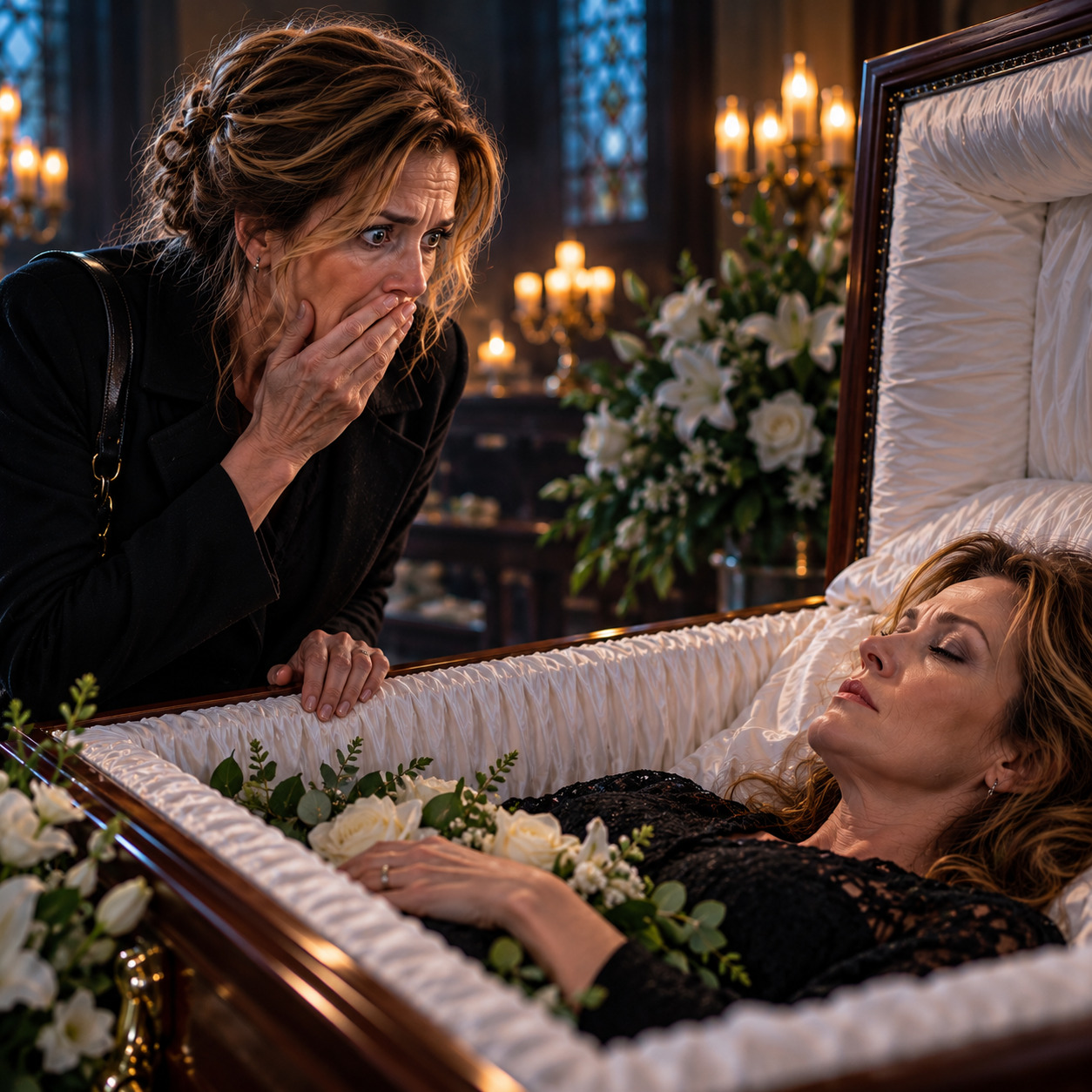
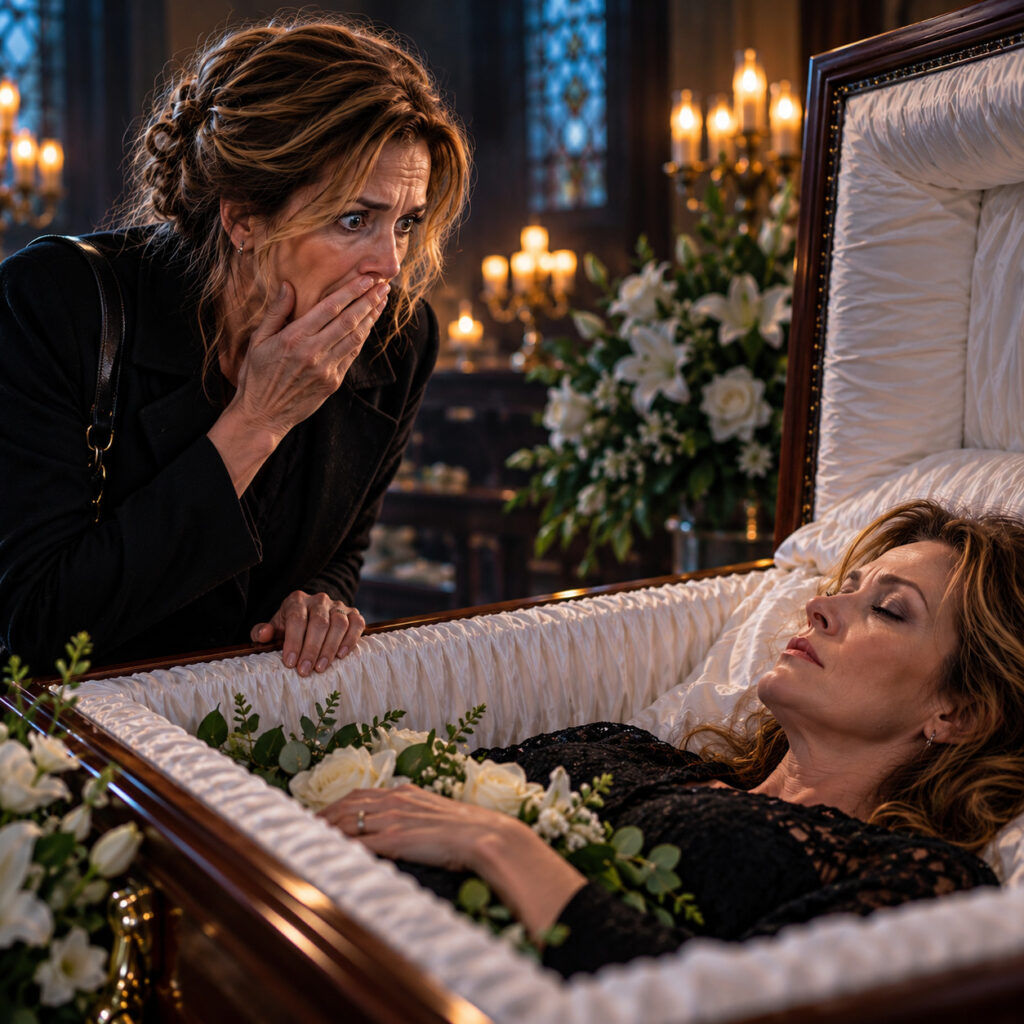
For several seconds after the woman spoke, Jessica could neither move nor make sense of what she had heard. The words were perfectly clear, delivered in a voice so like her own that she might have been listening to a recording. Yet the woman in the coffin had already closed her eyes, and her face had settled into the terrible stillness Jessica remembered from Thomas’s funeral.
“Don’t let her bury me.”
Jessica gripped the polished edge of the coffin. The room smelled of lilies, furniture polish, and something faintly medicinal beneath the flowers. Behind her, William Bellamy made a small sound, but she couldn’t bring herself to look at him.
She had spent the last hour trying to find a reasonable explanation for the announcement on the radio. Someone had made a mistake with the paperwork. Caroline had become involved in an elaborate misunderstanding. The dead woman was a relative whose resemblance to Jessica had been exaggerated by the unfamiliar surroundings.
Those explanations had seemed increasingly unlikely, but they had at least belonged to a world Jessica understood.
Now she wasn’t certain what she’d seen.
“Mr. Bellamy,” she said, “please call an ambulance.”
He didn’t answer.
Jessica turned. The funeral director stood near the doorway, one hand pressed against his chest. His face had lost its color.
“Did you hear her?”
Bellamy nodded slowly.
“Then call someone.”
He took out his telephone, fumbling with it before managing to place the call. Jessica listened as he explained that there had been an incident involving a deceased woman who might have shown signs of life. His professional vocabulary seemed to desert him halfway through the conversation.
While he spoke, Jessica looked back at the coffin.
The woman was wearing a dark green dress with a narrow collar. Jessica had owned one remarkably similar when Caroline was young, although hers had been donated to a charity shop years ago. The dead woman’s hair was darker than Jessica’s, without the silver strands that had begun appearing at her temples, and her skin was smooth enough to suggest someone several years younger.
But the face was hers.
Jessica had spent enough time looking at herself in mirrors to recognize the particular asymmetry of her features. Her left eyebrow sat slightly higher than the right. There was a tiny hollow beneath her lower lip and a scar near her chin that no amount of makeup had ever completely concealed.
She found herself wondering whether Caroline had noticed those details, too.
The thought was unbearable.
She reached toward the woman’s hand, then hesitated. The gold wedding band rested against the white flowers, catching the light from a lamp beside the coffin. Jessica knew the inscription inside it because she had watched Thomas struggle to conceal his delight when she first discovered it.
Forever, even after.
It had been an affectionate joke between them. Thomas liked to say that marriage was the only contract worth signing without reading the small print. Jessica had told him that sounded like the opinion of a man who had never negotiated a commercial lease.
She remembered their wedding day with sudden, painful clarity: Thomas’s nervous smile, the warm pressure of his fingers, and the certainty that whatever happened afterward, they would face it together.
Eleven years after his death, the memory could still catch her unprepared.
The ring had been in her jewelry box that morning.
She was certain of it.
Bellamy ended his call and approached cautiously.
“Someone’s coming,” he said.
Jessica nodded.
He glanced at the coffin but made no attempt to examine the woman.
“Mrs. Marsh, I need to ask you something.”
She waited.
“When you looked at her, before she opened her eyes, did you recognize her?”
Jessica studied his expression. There was something behind the question that troubled her.
“I recognized my own face.”
“That isn’t quite what I meant.”
“What did you mean?”
Bellamy seemed to regret having spoken.
“Nothing. Forgive me. It’s been a difficult evening.”
Jessica turned fully toward him.
“Mr. Bellamy, you accepted a body delivered under my name, arranged my funeral, and announced it publicly. Now you’ve seen something that should be impossible, and you’re asking whether I recognize the woman. I think it’s time you told me what you know.”
He looked exhausted.
“I know very little, Mrs. Marsh. Less than I ought to.”
“Then tell me what you do know.”
Bellamy lowered himself into one of the chairs arranged along the wall. For the first time, Jessica noticed that his hands were trembling.
“Your daughter came here on Monday afternoon. She was alone, and she seemed terribly tired. She had all the necessary documents, or what appeared to be the necessary documents, and she told me her mother had died at the family house on Wisteria Lane.”
Jessica remained standing beside the coffin.
“Did she say how?”
“She said it was unexpected. A doctor had attended, and the paperwork was in order.”
“Did she seem upset?”
“Yes. But not in the way I’d ordinarily expect.”
Jessica waited while he considered his words.
“She seemed frightened. She kept asking how soon the arrangements could be completed, and whether anyone would be permitted to see the body before the service.”
“What did you tell her?”
“That the family could make those decisions, within the usual requirements.”
“And?”
“She said there mustn’t be a viewing.”
Jessica looked back at the woman.
“Yet here I am.”
Bellamy nodded.
“Your daughter was very insistent. She said the coffin should remain closed.”
“Why?”
“She wouldn’t explain.”
Jessica tried to imagine Caroline sitting in this room, discussing funeral arrangements for a woman who looked exactly like her mother. She pictured her daughter signing forms, choosing flowers, and answering questions from a stranger while carrying whatever secret had kept her away for six months.
The image left Jessica feeling hollow.
“Did she give you an address where you could reach her?”
“Only the house on Wisteria Lane.”
“Did she leave a telephone number?”
“No.”
“Did she mention where she’d been?”
Bellamy shook his head.
Jessica sat beside him.
For a while, neither spoke.
She could hear the quiet movement of staff somewhere beyond the viewing room, the muted ring of a telephone, and a door closing at the far end of the corridor. The ordinary sounds were strangely reassuring.
“I need to find my daughter,” she said eventually.
Bellamy looked at her with an expression that was almost sympathetic.
“I understand.”
“No,” Jessica replied, more sharply than she intended. “I don’t think you do.”
She regretted it immediately.
Bellamy had done nothing to deserve the anger that had been building inside her for months. He was a stranger caught in circumstances neither of them understood.
“I’m sorry,” she said.
He shook his head.
“There’s no need.”
Jessica looked at the woman in the coffin.
“Caroline and I weren’t speaking when she disappeared. Not properly. We’d had an argument, and I thought she’d call when she was ready.”
Her voice faltered.
“After a few days, I became angry. Then frightened. Eventually, I stopped caring who’d been right.”
Bellamy said nothing.
“I just wanted her to come home.”
The admission settled between them.
Jessica had spoken those words to police officers, friends, and neighbors, but they sounded different in this room, with a dead woman wearing her face lying a few feet away.
She stood.
“I’m going to call the detective handling Caroline’s case.”
Bellamy nodded.
“I think that would be wise.”
Detective Rachel Bennett arrived forty minutes later.
She was a woman in her early forties, with closely cropped dark hair and the alert, practical manner Jessica had come to appreciate during the investigation into Caroline’s disappearance. They had met often enough over the previous six months that Bennett no longer needed to introduce herself.
When Jessica called, the detective had listened without interrupting. She asked several questions about the funeral arrangements, confirmed the address, and said she would come immediately.
Now she stood beside the coffin, examining the woman with an expression of controlled disbelief.
“You weren’t exaggerating,” she said.
Jessica gave a tired smile.
“I wish I had been.”
Bennett leaned closer to the body, studying the face and the small scar beneath the chin.
“Has anyone identified her independently?”
“Not that I know of.”
“And the paperwork?”
Bellamy handed over the folder.
Bennett examined the documents, paying particular attention to the death certificate.
“Dr. Nathaniel Price,” she read aloud. “Do you know him?”
Bellamy shook his head.
“The certificate was supplied by Miss Marsh.”
Bennett took out her telephone and made a call, asking someone to verify the doctor’s registration and the details recorded on the certificate.
Jessica watched her work.
The detective had never promised that Caroline would be found quickly. She had been careful with her language, explaining what the police knew and what they didn’t, even when Jessica desperately wanted reassurance.
That honesty had sometimes been difficult to bear, but Jessica trusted her because of it.
Bennett ended the call.
“We’ll need the medical examiner involved. Until we establish who this woman is and how she died, there won’t be a funeral.”
Bellamy nodded.
“Of course.”
Jessica felt some of the tension leave her shoulders.
“What about Caroline?”
“We’ll follow up on the arrangements she made here. If she was in Savannah on Monday, that’s the first confirmed sighting we’ve had in months.”
Jessica wanted to ask whether that meant Caroline was safe.
She didn’t.
Bennett looked at her.
“Tell me about Wisteria Lane.”
Jessica explained that the house had belonged to Thomas’s family and had stood empty since shortly after his death. She described the unsuccessful attempts to sell it and admitted that she hadn’t been inside for eleven years.
“Why not?” Bennett asked.
Jessica hesitated.
“It’s complicated.”
“Complicated how?”
She looked toward Bellamy, who was standing near the door.
“My husband didn’t want me to go back there.”
Bennett waited.
“He asked me not to, shortly before he died. I assumed it was because of his grandmother. They had a difficult relationship, and the house held unpleasant memories for him.”
“Did he give you a reason?”
“No.”
“Was there anything dangerous about the property?”
“Not that I knew of. It needed repairs, but nothing unusual for a house of that age.”
Bennett made a note.
“We’ll arrange to examine it. I’d prefer you didn’t enter the property until we’ve done that.”
Jessica nodded.
“Of course.”
The detective studied her for a moment.
“I mean it, Jessica.”
“I know.”
Bennett closed her notebook.
“You’ve had a difficult evening. Go home, get some rest, and let us do our job.”
Jessica almost laughed at the suggestion of sleep, but she was too tired to argue.
She collected her handbag and walked toward the door.
Before leaving, she looked back at the coffin.
The woman lay exactly as she had when Jessica first entered the room.
Her eyes were closed.
Her hands were still.
And the wedding ring remained on her finger.
Jessica wondered whether the words she’d heard had been intended as a warning or a plea.
She could not forget the fear in the woman’s eyes.
It was after nine when Jessica reached home.
The house stood in a quiet residential street, its porch light illuminating the steps and the flowerpots she’d been meaning to replace since spring. She parked in the driveway and sat for a moment, looking at the dark windows.
She had once loved coming home.
Thomas would usually be in the kitchen, cooking something unnecessarily complicated while listening to music. Caroline would be upstairs, pretending to do homework or talking to friends on the telephone.
There had been noise, arguments, laughter, and the comforting disorder of people sharing a life.
Now the house was silent.
Jessica let herself inside and switched on the hall light.
She left her handbag on the kitchen table, filled the kettle, and stood looking through the window while the water heated. Beyond the glass, the garden was dark, the outline of the old magnolia barely visible against the neighboring houses.
She made tea and carried it upstairs.
Her bedroom was much as it had been when Thomas was alive, although she’d replaced the curtains and moved some of the furniture. His books still occupied one shelf, and the small wooden box he’d given her for their tenth anniversary sat on the dressing table.
Jessica opened her jewelry box.
The wedding ring was gone.
She searched carefully, removing necklaces and earrings, checking the corners and the lining. She even looked beneath the dressing table, although she knew perfectly well that the ring had been inside the box when she’d last seen it.
Eventually, she sat on the edge of the bed.
Someone had been in her house.
The realization was more frightening than anything she’d experienced at the funeral home.
The woman in the coffin might have been an impossible mystery, but the missing ring suggested something immediate and personal. Someone had entered her bedroom, opened her jewelry box, and taken an object that belonged to Thomas.
Jessica reached for her telephone.
She was about to call Bennett when she noticed a small envelope beneath the jewelry box.
It was cream-colored and unsealed.
Her name was written across the front in Caroline’s handwriting.
For a long moment, Jessica simply stared at it.
Then she opened the envelope.
Inside was a single sheet of paper.
Mom,
I know you’ll be frightened, and I’m sorry. I never wanted any of this to happen.
I tried to find another way, but I couldn’t.
Please don’t go to Wisteria Lane until I can explain.
And whatever you do, don’t let them bury the woman in the coffin.
I love you.
Caroline.
Jessica read the note several times.
The handwriting was unmistakable.
So was the mixture of determination and apology that had characterized Caroline’s letters since childhood.
Jessica remembered a note her daughter had written at twelve after accidentally breaking a vase. She had admitted what happened, explained why it wasn’t entirely her fault, and promised to replace the vase when she had enough money.
Jessica had kept it for years.
She looked at the letter again.
Caroline had been here.
In this room.
Perhaps only hours earlier.
Jessica stood and searched the house, moving from room to room, checking doors and windows. Nothing appeared disturbed. The back door was locked, the kitchen window closed, and the spare bedroom exactly as she’d left it.
When she reached Caroline’s old room, she stopped.
The door was open.
Jessica rarely entered the room now. She had kept it much as Caroline left it when she moved into her own apartment, partly because she couldn’t decide what to do with the furniture and partly because changing it felt like another admission that her daughter was gone.
The bed was neatly made.
A few books remained on the shelves.
On the desk stood a framed photograph of Caroline and Thomas, taken during a family holiday in Florida.
Jessica moved closer.
Beside the photograph lay a small brass key.
She recognized it immediately.
It belonged to the front door of Wisteria Lane.
Jessica picked it up.
The metal was cold and slightly tarnished, the bow worn smooth from years of use.
She hadn’t seen the key since Thomas died.
For a moment, she stood in the quiet room, holding it in her palm.
Then she noticed something else.
The photograph had been moved.
Jessica knew because Caroline had always kept it angled toward the window, where the afternoon light caught the glass. Now it faced the doorway.
She lifted the frame.
Behind it was another photograph, much older, its edges curled and yellowed.
It showed a young woman standing on the steps of Wisteria Lane.
She wore a pale dress with a high collar, and her dark hair was arranged beneath a wide-brimmed hat. The photograph had the stiff formality of an early twentieth-century portrait.
Jessica turned it over.
On the back, in faded ink, someone had written:
Margaret Bell, 1912.
Jessica studied the woman’s face.
There was something familiar about her.
Not the features exactly, but the expression: the slightly raised chin, the direct gaze, the sense that the woman was watching something beyond the camera.
Jessica looked closer.
The woman wore a narrow gold band on her right hand.
Jessica felt a chill.
It was impossible to see the inscription, but the ring appeared remarkably similar to Thomas’s wedding band.
She placed the photograph on the desk and sat down.
For the first time, she began to understand that Caroline’s disappearance might not have been an impulsive decision or an attempt to escape their troubled relationship.
Her daughter had been investigating something.
Something connected to Thomas’s family.
Something that had frightened her enough to disappear for six months.
And now Caroline had returned, leaving warnings instead of explanations.
Jessica looked at the brass key.
She remembered Thomas standing in their kitchen three days before he died, his face drawn with exhaustion.
He had asked her to promise that she would never return to Wisteria Lane.
She had laughed at the time, telling him that she had no intention of visiting a house that smelled of damp plaster and old furniture.
But Thomas hadn’t smiled.
He had taken her hand and repeated the request.
“Promise me, Jess.”
She had promised.
Now, eleven years later, she wondered what he had known.
And why he had been so afraid.
Jessica slept badly.
She dreamed of the funeral home, of the woman in the coffin, and of Caroline standing at the far end of a corridor that seemed to stretch farther away whenever Jessica tried to reach her.
When she woke, sunlight was filtering through the curtains.
For a moment, she lay still, trying to separate the dream from the previous evening.
Then she remembered the letter.
She sat up.
The envelope lay on her bedside table, exactly where she’d left it.
Jessica reached for her telephone.
There was a message from Detective Bennett.
We’ve confirmed that the doctor named on the death certificate does not appear to be licensed in Georgia. We’re investigating the documents. Please call me when you’re awake.
Jessica read it twice.
Then she called.
Bennett answered almost immediately.
“Jessica. How are you?”
“I’ve been better.”
“I can imagine.”
Jessica told her about the missing wedding ring, Caroline’s letter, the brass key, and the photograph.
Bennett listened carefully.
“Don’t touch anything else,” she said. “I’ll send someone to collect the letter and photograph. We may be able to establish when Caroline was there.”
“Do you think she’s still in Savannah?”
“I think it’s possible.”
Jessica looked toward the bedroom door.
“Rachel, there’s something else.”
“What?”
“Thomas asked me never to return to Wisteria Lane. He was frightened of the place.”
Bennett was quiet for a moment.
“Did he ever explain why?”
“No.”
“Then we need to find out.”
Jessica felt a small measure of relief.
For the first time since Caroline disappeared, someone else seemed to understand that the house mattered.
“We’ll examine the property today,” Bennett continued. “I’ll call you when we’re finished.”
Jessica thanked her and ended the call.
She dressed, made breakfast, and tried to occupy herself with ordinary tasks while waiting for the police.
By late morning, she had cleaned the kitchen, answered three emails from customers, and rearranged the contents of a cupboard that hadn’t needed rearranging.
At eleven thirty, her telephone rang.
It was Bennett.
“Jessica, we’ve been to Wisteria Lane.”
Jessica sat down.
“And?”
“The house is empty.”
“Did you find anything?”
“Nothing that immediately explains what happened. There are signs someone has been inside recently, but no indication of where Caroline might have gone.”
Jessica closed her eyes.
“Was there anything unusual?”
Bennett hesitated.
“The house is in poor condition. Several rooms are locked, and we’ll need to arrange access to those before we can complete the examination.”
“Which rooms?”
“Two upstairs bedrooms and a small room at the back of the second floor.”
Jessica felt her stomach tighten.
The small room.
Thomas’s grandmother had used it as a private sitting room. As far as Jessica knew, nobody had entered it since Augusta’s death.
“Rachel, that room was always locked.”
“Do you have a key?”
“No.”
“Then we’ll arrange for someone to open it.”
Jessica looked toward the brass key lying on the kitchen table.
“Can I come to the house?”
“I’d rather you waited until we’ve finished.”
“Please. I know the property. I might recognize something you’ve missed.”
Bennett considered.
“All right. But only when I call you. And Jessica?”
“Yes?”
“Don’t go inside alone.”
Jessica promised.
After ending the call, she remained at the kitchen table for several minutes.
The house on Wisteria Lane had stood empty for eleven years.
Caroline had disappeared while investigating it.
A woman wearing Jessica’s face had been brought from there to a funeral home.
And Thomas had been frightened enough of the place to ask his wife for a promise he would never live to see her keep.
Jessica looked at the brass key.
For the first time, she wondered whether Thomas had been protecting her from something inside the house.
Or whether he had been protecting something inside the house from her.